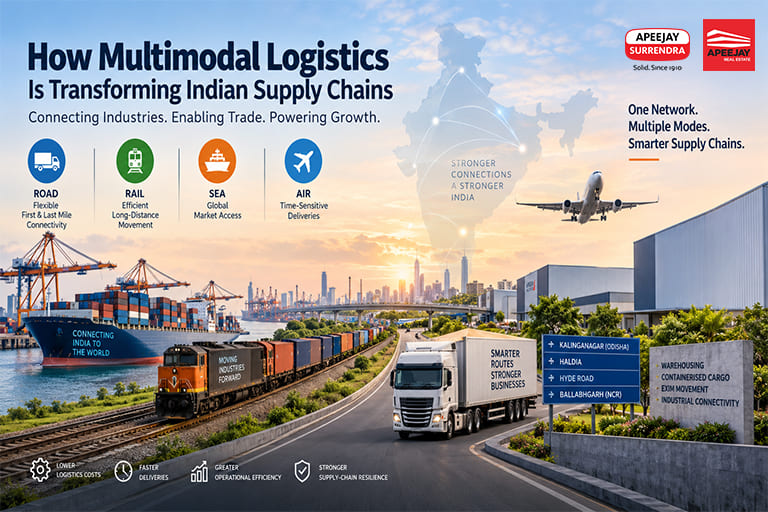
India’s supply chains are evolving rapidly as manufacturing, trade and consumption expand across regions. Businesses today need logistics networks that are not only faster, but also more flexible, efficient and resilient. Multimodal logistics is playing an important role in enabling this transformation.
Multimodal logistics integrates road, rail, sea and air transportation into a connected network. Each mode serves a different purpose—road provides flexible first- and last-mile connectivity, rail supports efficient long-distance cargo movement, sea connects businesses with global markets, while air enables time-sensitive transportation. Together, they allow businesses to select smarter routes based on cost, cargo type, distance and delivery timelines.
Why Multimodal Connectivity Matters-
An integrated transportation network can help businesses achieve faster deliveries, lower logistics costs and greater operational efficiency. Cargo can move between different modes depending on what is most suitable for each stage of its journey, reducing dependence on any single transportation channel.
This flexibility also contributes to stronger supply-chain resilience. When businesses have access to multiple transportation options and strategically connected logistics infrastructure, they are better positioned to respond to congestion, delays and changing market requirements.
Logistics Infrastructure::Connecting the Modes-
The effectiveness of multimodal logistics depends heavily on infrastructure that can connect transportation networks with manufacturing centres, warehouses, ports and consumption markets.
Apeejay Real Estate has developed its logistics presence around this evolving requirement. At Kalinganagar, Odisha, its logistics infrastructure supports warehousing, containerised cargo and EXIM movement, helping connect the Eastern region’s industrial ecosystem with broader domestic and international supply chains.
Similarly, Apeejay Real Estate’s other logistic parks presence at Haldia and Hyde Road in eastern India and Ballabhgarh in the NCR region supports businesses across strategically important industrial and consumption markets.
Towards a More Connected Logistics Future-
As India strengthens its manufacturing and trade ecosystem, the future of logistics will increasingly depend on how efficiently infrastructure and transportation modes work together.
Multimodal logistics represents a shift from simply moving cargo to intelligently connecting supply chains. With better integration between road, rail, sea and air, businesses can build networks that are faster, more efficient and better prepared for future growth.
For Apeejay Real Estate, this evolution aligns with a long-standing focus on creating logistics infrastructure that supports the changing needs of businesses and India’s growing economy – One Network. Multiple Modes. Smarter Supply Chains!